Blog Archive

Wednesday, September 6, 2023

Harnessing the Power of GenAI +Traditional AI for Effective Data Management

Author: Bidisha Chatterjee, Sr Manager Data Engineering

In today's rapidly evolving tech landscape, data has emerged as the lifeblood of businesses, steering decision-making, sparking innovation, and propelling growth. But with the exponential surge in data volumes, organizations now grapple with unprecedented challenges in managing, processing, and extracting actionable insights from their data repositories. Fear not, for a dynamic duo stands ready to revolutionize data management: GenAI and traditional AI.


 Understanding GenAI and Traditional AI

Before we dive into the symphony of GenAI and traditional AI harmonizing together, let's acquaint ourselves with these two superheroes:

Traditional AI: These stalwart artificial intelligence systems rely on rule-based algorithms and predefined logic to perform their tasks. They excel in structured data environments, automating repetitive tasks, performing classification, and conducting statistical analysis with finesse.

GenAI (Generative AI): On the flip side, GenAI represents a newer breed of artificial intelligence, wielding the power of deep learning techniques like GANs (Generative Adversarial Networks) and transformers. Its superpower? Generating data, images, text, and more with incredible finesse, making it an invaluable asset for training and testing AI models.


 The Synergy between GenAI and Traditional AI in Data Management space

Now, let's explore how these two extraordinary beings can come together to work wonders:

Data Augmentation

- GenAI serves as the maestro of data augmentation, conjuring synthetic data to complement existing datasets.

- Traditional AI models, hungry for diversity, feast on this rich training data, enhancing their accuracy and resilience.

- Think of it as a painter expanding their palette to create more vibrant art.

 Data Cleansing

- Traditional AI, our vigilant detective, excels at spotting anomalies and errors in structured data.

- When paired with GenAI's talent for generating clean and consistent synthetic data, you have an unmatched team.

- Together, they elevate data quality to new heights, ensuring your data is squeaky clean.

Data Labeling

- Labeling vast datasets is a labor-intensive endeavor, but GenAI comes to the rescue.

- By generating synthetic data with precise labels, it lightens the load on human annotators.

- Traditional AI algorithms then step in, trained on this labeled data to perform tasks like classification and object detection.

Data Privacy

- GenAI possesses a unique ability: generating synthetic data that preserves the statistical essence of the original while safeguarding individual privacy.

- In industries like healthcare and finance, where data is sensitive, this is a game-changer.

- Traditional AI can then operate on this anonymized data without compromising privacy, a win-win scenario.

 Data Generation for AI Training

- Need to train your AI models? GenAI crafts tailor-made synthetic text, images, or audio data.

- Traditional AI fine-tunes these models with real-world data, ensuring they're primed for action.

- It's like giving your AI a tailored suit for every occasion.

Streamlining Data Pipelines

- GenAI and traditional AI are the dream team for optimizing data pipelines.

- GenAI provides synthetic data for testing and validation, reducing the reliance on precious real data.

- Traditional AI automates data ingestion, transformation, and integration processes, streamlining efficiency.

Challenges and Considerations

Of course, every superhero has their challenges and responsibilities:

Data Quality: Ensure that the synthetic data generated by GenAI meets the highest quality standards. Poorly generated data can lead AI models astray.

Ethical Concerns: Prioritize privacy and ethical considerations when dealing with sensitive information, a responsibility we must uphold as data stewards.

Training and Expertise: Successfully implementing GenAI and traditional AI solutions demands a skilled team of data scientists and AI experts who can navigate both realms.

In conclusion, the partnership of GenAI and traditional AI holds tremendous promise for data management. GenAI's ability to generate synthetic data seamlessly complements traditional AI's prowess in structured data analysis, paving the way for more robust and efficient data-driven solutions. As organizations continue to grapple with the ever-increasing data deluge, this combined approach stands as a game-changer in the realm of data management, driving innovation and insights like never before. 💪📊🚀 

Tuesday, September 5, 2023

What is Data Mesh and How Can It Help Your Organization?


Introduction:

In today’s data-driven world, organizations are faced with the ever-growing challenge of how to effectively manage, process, and extract insights from their data. Traditional data management approaches have begun to show their limitations as data volumes explode and the need for agility and collaboration becomes paramount. Enter Data Mesh, a revolutionary concept that promises to reshape the way organizations handle their data ecosystems. The term data mesh was first introduced in a May 2019 blog post by Zhamak Dehghani, founder and CEO of NextData. In December 2020, Dehghani further clarified what a data mesh is and set out four underpinning principles. Data mesh architectures have been an extremely hot topic ever since.


How Does Data Mesh works?

The Data Mesh architecture is a decentralized approach to data management that aligns data domains with specific business capabilities. Each data domain is responsible for the data that is created and used within its domain. The data domains own and manage their data, and they define and enforce governance policies specific to their data products. The central data team provides support and infrastructure, but the data domains are ultimately responsible for the quality and security of their data.

Here is a more detailed explanation of each component of the Data Mesh architecture:

  • Domain-oriented ownership: This means that the teams that use the data are also responsible for owning and managing it. This gives the teams a vested interest in ensuring the quality and security of the data.
  • Self-serve data infrastructure: This refers to the tools and resources that the data domains need to access and process data on their own. This reduces the reliance on the central data team and allows the data domains to be more agile and responsive to their needs.
  • Federated data governance: This means that the responsibility for data governance is shared between the data domains and the central data team. The data domains define the governance policies for their own data products, and the central data team provides support and guidance. This approach allows for more flexibility and customization, while still ensuring that the data is managed in a consistent and secure manner.

Benefits of Data Mesh

The Data Mesh architecture offers several benefits over traditional data architectures, including:

  • Agility: Data teams can respond more quickly to changing business needs because they are not dependent on a central data team.
  • Quality: Data owners are more likely to take responsibility for the quality of their data because they are the ones who use it.
  • Collaboration: Data teams can more easily share data with each other because they are all working with the same data products.
  • Resilience: The Data Mesh architecture is more resilient to changes in the data landscape because data is not stored in a single location.

In addition to these benefits, the Data Mesh architecture can also lead to:

  • Faster time to insight: Business stakeholders gain access to real-time and relevant data, enabling faster decision-making and a competitive edge in the market.
  • Enhanced collaboration: Domain-specific data product teams collaborate effectively, breaking down data silos and fostering a culture of knowledge sharing and innovation.
  • Empowered business users: Self-serve analytics empower business users to explore data independently, leading to data-driven insights and better business outcomes.

The Challenges of Data Mesh:

Here are some additional details about each of these challenges:

  • Data governance: In a Data Mesh architecture, each data domain is responsible for the quality and security of its own data products. This can be a challenge, as it requires each data domain to have a strong understanding of data governance principles and practices. It is also important to have a clear governance framework in place that defines the roles and responsibilities of each data domain.
  • Complexity: The Data Mesh architecture is a more complex approach to data management than traditional data architectures. This is because it requires the coordination of multiple data domains, each with its own data products and governance policies. It is important to have a clear understanding of the Data Mesh architecture before implementing it, and to have a plan in place for managing the complexity.
  • Culture change: The Data Mesh architecture requires a cultural shift in the way that data is managed. In a traditional data architecture, the central data team is responsible for managing all of the data in the organization. In a Data Mesh architecture, the data domains are responsible for managing their own data products. This requires a change in mindset from the data teams, who need to be empowered to take ownership of their data.

Despite these challenges, the Data Mesh architecture can be a valuable approach to data management for organizations that are looking to improve their agility, quality, collaboration, and resilience. If you are considering implementing the Data Mesh architecture, it is important to carefully assess your organization’s needs and capabilities.

Implementing Data Mesh requires a strategic approach:

Assessment and strategy development: Begin by assessing your organization’s data landscape. Identify areas that can benefit from a Data Mesh approach and craft a strategy that outlines how Data Mesh aligns with your broader data strategy.

Domain identification and ownership: Divide your data ecosystem into distinct domains, each with its own ownership, goals, and metrics. This step is crucial for defining the boundaries within which teams operate.

Treating data as products: Within each domain, define data products — sets of data that are consumed by various parts of the organization. Establish clear contracts for data production, consumption, and quality.

Platform and infrastructure considerations: Invest in the right technology stack to support your Data Mesh implementation. This could involve tools for data discovery, data lineage tracking, and enabling self-serve data access to domain teams.

Empowering domain teams: Equip domain teams with the skills, tools, and autonomy they need to effectively manage their data. Foster a culture of collaboration and ownership to encourage innovation and accountability.

Governance and standards: Strike a balance between domain autonomy and centralized governance. Establish guidelines for data quality, security, and interoperability across domains to maintain consistency while allowing for domain-specific customization.

Monitoring and iteration: Implement a robust monitoring system to track the performance of your Data Mesh implementation. Continuously gather feedback from teams and stakeholders, and iterate on your strategy to adapt to evolving needs.

Conclusion:

In a data-centric world where agility, collaboration, and scalability are paramount, Data Mesh emerges as a groundbreaking solution. By reimagining data architecture, embracing decentralized ownership, and fostering a culture of collaboration, organizations can overcome the challenges of traditional data management approaches. While the implementation of Data Mesh requires careful planning and execution, the rewards in terms of improved data utilization, faster innovation, and streamlined operations are well worth the effort.

Additional Resources

· Data Mesh Principles and Logical Architecture

· Data Mesh by Zhamak Dehghani

· Articles discussing real-world benefits and challenges of adopting Data Mesh

Sunday, July 9, 2023

Data Governance and Security: Safeguarding the Foundation of Your Data Strategy

Introduction:
In today's data-driven world, organizations face growing challenges in ensuring the security, privacy, and integrity of their data assets. This blog post delves into the critical aspects of data governance and security, exploring why they are essential components of a robust data strategy and providing practical guidance for implementing effective measures.
The Importance of Data Governance:
Defining data governance and its significance in managing data assets
Linking data governance to regulatory compliance, risk management, and data quality
Establishing a data governance framework and aligning it with business goals
Building a Data Governance Framework:
Identifying data governance roles and responsibilities within an organization
Defining data policies, standards, and guidelines for data management
Implementing data stewardship programs and establishing data governance committees
Data Classification and Data Lifecycle Management:
Categorizing data based on sensitivity, importance, and regulatory requirements
Implementing data classification frameworks and metadata management
Developing data lifecycle management strategies to ensure data is properly handled from creation to deletion
Data Privacy and Compliance:
Understanding data privacy regulations (e.g., GDPR, CCPA) and their implications
Implementing data protection measures, including encryption and access controls
Conducting privacy impact assessments and ensuring transparency in data handling
Data Security Best Practices:
Implementing robust authentication and authorization mechanisms
Establishing secure data transmission protocols (e.g., SSL/TLS)
Regularly monitoring and auditing data access and activities for suspicious behavior
Data Breach Preparedness and Incident Response:
Developing data breach response plans and procedures
Conducting regular security assessments and vulnerability testing
Establishing incident response teams and protocols for quick and effective action
Vendor and Third-Party Risk Management:
Evaluating and selecting trusted partners and service providers
Assessing and managing data security risks associated with outsourcing
Ensuring compliance with security standards and contracts
Employee Training and Awareness:
Educating employees on data governance policies, security best practices, and compliance
Conducting regular training sessions and awareness campaigns
Encouraging a culture of data security and privacy awareness throughout the organization
Conclusion:
Data governance and security are foundational pillars of a successful data strategy. By implementing comprehensive data governance frameworks, robust security measures, and ongoing monitoring and training, organizations can protect their data assets, ensure regulatory compliance, and build trust with stakeholders. Embracing data governance and security as strategic priorities will pave the way for a secure and ethical data-driven environment.

Saturday, July 1, 2023

Commonly asked interview questions for a Data Architect role

Q1- What is the role of a Data Architect in an organization?

Answer: A Data Architect plays a critical role in designing and implementing the organization's data infrastructure. They are responsible for creating data models, defining data storage and integration strategies, ensuring data quality and security, and enabling efficient data access and analysis. Additionally, they collaborate with stakeholders to understand business requirements and translate them into scalable and performant data solutions.

Q2-What are the key components of a data architecture?

Answer: A data architecture typically comprises several key components:

Data sources: These are the systems, databases, applications, and external sources from which data is collected.
Data storage: It involves selecting appropriate technologies and structures for storing structured and unstructured data, such as data lakes, data warehouses, or relational databases.
Data integration: This involves designing mechanisms to efficiently ingest and integrate data from various sources into a unified view.
Data processing: It includes designing data pipelines, transformations, and data processing frameworks for data enrichment and analysis.
Data governance: It encompasses defining policies, standards, and procedures for data management, data quality, metadata, and security.
Data access and visualization: This component focuses on enabling data discovery, access, and visualization for business users through tools and interfaces.
Q3-What are some best practices for data modeling?
Answer: Data modeling is crucial for structuring and organizing data effectively. Here are some best practices:

Understand business requirements: Work closely with stakeholders to gather requirements and align data models with business needs.
Choose the right modeling technique: Depending on the use case, select an appropriate modeling technique like entity-relationship (ER) modeling, dimensional modeling, or graph modeling.
Normalize and denormalize data: Normalize data to eliminate redundancy and ensure data integrity. Denormalize data where performance and query optimization are critical.
Establish naming conventions and standards: Define consistent naming conventions for entities, attributes, and relationships to ensure clarity and maintainability.
Use appropriate data types: Select appropriate data types that accurately represent the data and optimize storage and processing efficiency.
Document and maintain models: Document models thoroughly and keep them up to date as the data landscape evolves.
How do you ensure data quality in a data architecture?
Answer: Ensuring data quality is essential for reliable data analysis. Here are some approaches:

Data profiling: Perform data profiling to understand data patterns, anomalies, and data quality issues.
Data cleansing: Implement data cleansing processes to correct data errors, remove duplicates, and standardize data formats.
Data validation: Apply data validation rules and checks during data ingestion and transformation to ensure data accuracy and integrity.
Data lineage tracking: Establish data lineage to track the origin, transformation, and movement of data to ensure its traceability and reliability.
Data quality monitoring: Continuously monitor data quality through automated checks, exception reporting, and proactive data quality metrics.
Data governance: Implement data governance practices to enforce data quality standards, define data ownership, and establish data stewardship roles.

Q4-How do you approach data security in a data architecture?
Answer: Data security is a critical aspect of a data architecture. Here's an approach to ensure data security:

Access controls: Implement role-based access controls (RBAC) and fine-grained permissions to restrict data access based on user roles and responsibilities.
Encryption: Employ encryption techniques to protect data at rest and in transit. Utilize encryption algorithms and key management practices provided by the cloud platform or industry standards.
Data masking and anonymization: Mask or anonymize sensitive data to protect individual privacy and comply with data protection regulations.
Audit and monitoring: Implement logging and monitoring mechanisms to track data access, changes, and potential security breaches. Regularly review audit logs for suspicious activities.
Security policies: Define and enforce security policies, including password policies, data classification, and data retention policies.
Regular security assessments: Conduct periodic security assessments, vulnerability scans, and penetration testing to identify and address potential security risks.

Q5-What is real-time data processing, and how is it different from batch processing?
Answer: Real-time data processing refers to the ability to process and analyze data as it arrives, providing immediate insights and responses. It allows for instantaneous decision-making and actions based on up-to-date information. In contrast, batch processing involves processing data in large volumes at scheduled intervals. Real-time processing is characterized by low latency, near-instantaneous processing, and continuous data ingestion, while batch processing is suitable for large-scale data analysis but may have higher latency. Q6-How do you design a real-time data processing architecture?
Answer: Designing a real-time data processing architecture involves several components: Data ingestion: Implement mechanisms to collect and ingest data in real-time, such as using event-driven architectures or streaming platforms like Apache Kafka. Data processing: Utilize scalable and fault-tolerant frameworks like Apache Spark or Apache Flink to process incoming data streams, perform transformations, enrichments, aggregations, and computations. Message queues and event-driven systems: Use technologies like RabbitMQ or Apache Pulsar to handle high-throughput data streams and ensure reliable message delivery. Real-time analytics: Integrate tools like Apache Druid or Elasticsearch to enable real-time analytics and querying of the processed data. Visualization and alerts: Connect the processed data to visualization tools or alerting systems to provide real-time insights and notifications for business stakeholders.
Q7-How do you ensure data consistency and reliability in a real-time data processing system? Answer: Ensuring data consistency and reliability in real-time data processing systems involves the following measures: Idempotent processing: Design processing logic to be idempotent, meaning that processing the same data multiple times has the same result, ensuring data consistency in case of retries or failures. Data validation: Implement data validation checks during ingestion and processing stages to identify and handle data quality issues or anomalies. Error handling and fault tolerance: Employ fault-tolerant processing frameworks that can handle failures gracefully and provide mechanisms like automatic retries or error queues for processing failures. Data replication and backup: Replicate and backup critical data to prevent data loss in case of failures. Monitoring and alerts: Implement robust monitoring and alerting systems to detect and respond to issues promptly, ensuring data reliability and system uptime.
Q8-How do you address scalability challenges in real-time data processing?
Answer: Scalability is crucial in real-time data processing to handle increasing data volumes and growing user demands. Some approaches to address scalability challenges include: Distributed processing: Utilize distributed processing frameworks like Apache Spark or Apache Flink that can scale horizontally across a cluster of machines to handle large data workloads. Data partitioning: Implement data partitioning techniques to distribute data across multiple processing nodes, enabling parallel processing and minimizing bottlenecks. Auto-scaling: Leverage cloud platforms that offer auto-scaling capabilities, allowing the system to dynamically provision or deprovision resources based on workload demands. Microservices architecture: Adopt a microservices architecture to decompose the system into smaller, independently scalable services, each responsible for specific processing tasks. Caching and in-memory computing: Utilize in-memory caching techniques to store frequently accessed data, reducing the need for repeated computations and improving overall system performance.
Q9-How do you ensure low-latency processing in a real-time data architecture?
Answer: Achieving low-latency processing in a real-time data architecture involves the following strategies: Use efficient data serialization formats: Choose compact and efficient serialization formats like Apache Avro or Protocol Buffers to minimize data transmission and processing overhead. Streamline data transformations: Optimize data transformation and processing logic to minimize computational complexity and reduce latency. Data partitioning and parallel processing: Implement data partitioning techniques and parallel processing frameworks to distribute the workload across multiple processing nodes, enabling faster data processing. Utilize in-memory caching: Leverage in-memory caching technologies to store intermediate results or frequently accessed data, reducing disk I/O and improving processing speed. Optimize network and infrastructure: Ensure high-speed network connectivity and utilize high-performance infrastructure to minimize network latency and processing delays.

Good luck with your interview!

Designing an Efficient Data Lake on a Cloud Environment: A Comprehensive Guide

Introduction: 
In today's data-driven world, organizations are increasingly recognizing the value of storing and analyzing vast amounts of data to gain insights and drive informed decision-making. To effectively manage this wealth of information, many businesses are turning to cloud environments and leveraging the power of data lakes. A data lake provides a scalable and cost-effective solution for storing and processing large volumes of structured and unstructured data. In this blog post, we will explore the key considerations and best practices for designing a robust data lake in a cloud environment.


Define Your Objectives:
Before diving into the design process, clearly define the objectives of your data lake. Determine what type of data you intend to store, the scale of the data, and the analytical use cases you plan to address. Understanding your goals will help shape the architecture and inform the selection of appropriate cloud services.


Choose the Right Cloud Platform:
Several major cloud providers offer reliable infrastructure and services for building data lakes, such as Amazon Web Services (AWS), Microsoft Azure, and Google Cloud Platform (GCP). Evaluate each platform based on your requirements, including storage options, data processing capabilities, security features, and cost models. Consider factors like scalability, performance, and integration with existing systems.

Plan for Data Ingestion:
Efficient data ingestion is crucial for a successful data lake design. Identify the sources of data and the ingestion patterns required. Cloud platforms provide various ingestion mechanisms like batch processing, streaming, or event-based approaches. Evaluate services like AWS Glue, Azure Data Factory, or Google Cloud Dataflow to automate and streamline the data ingestion process.

Ensure Data Quality and Governance:
Maintaining data quality and enforcing governance policies are vital for a reliable and trustworthy data lake. Implement data validation and cleansing processes to eliminate errors and inconsistencies. Establish data governance practices to define access controls, data classification, and metadata management. Leverage services like AWS Lake Formation, Azure Purview, or GCP Data Catalog to govern your data effectively.

Optimize Data Storage:
Choose the appropriate storage technology based on your data characteristics and access patterns. Cloud providers offer a range of options like object storage (e.g., Amazon S3, Azure Blob Storage, or Google Cloud Storage), columnar databases (e.g., AWS Redshift, Azure Synapse Analytics, or Google BigQuery), or file systems (e.g., Hadoop Distributed File System on the cloud). Understand the pros and cons of each storage option and leverage data compression and partitioning techniques to improve performance and reduce costs.

Implement Data Security:
Data security should be a top priority in your data lake design. Ensure end-to-end encryption of data both in transit and at rest. Implement robust access controls, including fine-grained permissions and role-based access policies. Regularly monitor and audit access logs to detect any anomalies or unauthorized activities. Cloud providers offer various security features and services like AWS Identity and Access Management (IAM), Azure Active Directory, or GCP Cloud Identity and Access Management (IAM) to secure your data lake.

Embrace Data Cataloging and Metadata Management:
Efficient data discovery and exploration are essential for data lake users. Implement a comprehensive data catalog and metadata management solution to enable users to search and understand the available data assets. Leverage automated metadata extraction, data lineage tracking, and tagging mechanisms to enhance data discoverability and improve the overall data lake experience.

Consider Data Processing and Analytics:
Enable data processing and analytics capabilities within your data lake environment. Cloud platforms provide services like AWS Glue, Azure Databricks, or Google Cloud Dataproc, which offer scalable data processing frameworks like Apache Spark. Leverage serverless computing options like AWS Lambda, Azure Functions, or GCP Cloud Functions to build data processing pipelines and perform real-time analytics on streaming data.

Monitor Performance and Optimize Costs:
Regularly monitor the performance and usage patterns of your data lake environment. Utilize cloud-native monitoring tools and services to gain insights into resource utilization, query performance, and data access patterns. Optimize storage costs by implementing data lifecycle management policies and leveraging cost-effective storage tiers offered by cloud providers.

Conclusion:
Designing an efficient data lake in a cloud environment requires careful planning and consideration of various factors. By defining your objectives, choosing the right cloud platform, implementing data ingestion and governance strategies, optimizing storage, ensuring data security, and embracing data processing and analytics capabilities, you can build a scalable and cost-effective data lake that unlocks the full potential of your organization's data assets. Remember to continuously monitor and optimize your data lake to adapt to changing business needs and evolving cloud technologies.

Friday, March 5, 2021

Data Lake design Architecture

What is Data Lake ?


  • Data Lake is a huge repository that holds every kind of data in its raw format until it is needed by anyone in the organization to analyze.
  • Data Lake is not Hadoop. It uses different tools. Hadoop only implements a subset of functionalities
  • Data Lake is not a database in the traditional sense of the word. A typical implementation of Data Lake uses various NoSQL and In-Memory databases that could co-exist with its relational counterparts.
  • A Data Lake cannot be implemented in isolation. It has to be implemented alongside a data warehouse as it complements various functionalities of a DW.
  • It stores large volumes of both unstructured and structured data. It also stores fast-moving streamed data from machine sensors and logs.
  • It advocates a Store-All approach to huge volumes of data.
  • It is optimized for data crunching with a high-latency batch mode and it is not geared for transaction processing.
  • It helps in creating data models that are flexible and could be revised without database redesign.
  • It can quickly perform data enrichment that helps in achieving data enhancement, augmentation, classification, and standardization of the data.
  • All of the data stored in the Data Lake can be utilized to get an all-inclusive view. This enables near-real-time, more precise predictive models that go beyond sampling and aid in generating multi-dimensional models too
  • It is a data scientist's favorite hunting ground. He gets to access the data stored in its raw glory at its most granular level, so that he can perform any ad-hoc queries, and build an advanced model at any time—Iteratively. The classic data warehouse approach does not support this ability to condense the time between data intake and insight generation.
  • A key attribute of a Data Lake is that data is not classified when it is stored. As a result, the data preparation, cleansing, and transformation tasks are eliminated; these tasks generally take a lion's share of time in a Data Warehouse. 

Thursday, April 18, 2019

Data Modeling in Hadoop

As we always hear in the context of Hadoop is Schema on Read . 
Above statement simply mean that raw and unprocessed data can be loaded into Hadoop.

Although being able to store all of our raw data is a powerful feature, there are still many factors that we should take into consideration before dumping our data into Hadoop. These considerations include:

Data storage formate: many kinds of file formate generate by the business and Hadoop can support them all. Each file format has there strength that makes it better suited for the application.Hadoop provides HDFS to store the data but on top of HDFS, there are many kinds of additional data access tools available like HBase and HIVE.Hbase for additional data access functionality Hive is for additional data management functionality.

Multitenancy: It’s common for clusters to host multiple users, groups, and application types.
Supporting multitenant clusters involves a number of important considerations when you are planning how data will be stored and managed.

Schema design: Despite the schema-less nature of Hadoop, there are still important considerations
to take into account around the structure of data stored in Hadoop. This includes directory structures for data loaded into HDFS as well as the output of data processing and analysis. This also includes the schemas of objects stored in systems such as HBase and Hive.

Metadata management: As with any data management system, metadata related to the stored data is often as important as the data itself. Understanding and making decisions related to metadata management are critical.

Security : This includes decisions around authentication, fine-grained access control, and encryption—both for data on the wire and data at rest.

Data extraction in Big data-Hadoop

Extraction and ingestion of the data from various sources and store into HDFS environment is a challenging task.
There are various techniques and application available to ingest large scale data into HDFS.
In this blog, we will see how to Import data from MySql to Hadoop

1- Importing data from MySQL into hdfs using SQOOP

Sqoop is an Apache project that is part of the Hadoop ecosystem. Sqoop is built on top of MapReduce and take advantage of its parallelism and fault tolerance. Instead of moving data between
clusters, Sqoop was designed to move data from and into relational databases using a JDBC driver to connect.

Note: Mysql driver can be downloaded from http://dev.mysql.com/downloads/connector/j/

Steps to do :

Complete the following steps to move data from a MySQL table to an HDFS file:

Step1: Create a new database in the MySQL database:
                   CREATE DATABASE weblogs;

Step2: Create and load the weblogs table:

 USE weblogs;
CREATE TABLE weblogs(
md5                           VARCHAR(32),
url                             VARCHAR(64),
date                           DATE,
time                          TIME,
ip address                  VARCHAR(15)
);
LOAD DATA INFILE '/path/weblog.txt' INTO TABLE weblogs
FIELDS TERMINATED BY '\t' LINES TERMINATED BY '\r\n';

Step3: Select a count of rows from the weblogs table:

mysql> select count(*) from weblogs;
The output would be:
+----------+
| count(*) |
+----------+
| 2500 |
+----------+
1 row in set (0.01 sec)

Step 4: Import the data from MySQL to HDFS:

sqoop import -m 1 --connect jdbc:mysql://<HOST>:<PORT>/logs

--username bigdata --password bigdata --table weblogs --target-dir /
data/weblogs/import

The output would be:

INFO orm.CompilationManager: Writing jar file:
/tmp/sqoop-jon/compile/f57ad8b208643698f3d01954eedb2e4d/weblogs.
jar
WARN manager.MySQLManager: It looks like you are importing from
mysql.
WARN manager.MySQLManager: This transfer can be faster! Use the
--direct
WARN manager.MySQLManager: option to exercise a MySQL-specific
fast path.
...
INFO mapred.JobClient: Map input records=2500
INFO mapred.JobClient: Spilled Records=0
INFO mapred.JobClient: Total committed heap usage
(bytes)=8500003435
INFO mapred.JobClient: Map output records=2500
INFO mapred.JobClient: SPLIT_RAW_BYTES=83
INFO mapreduce.ImportJobBase: Transferred 200.2451 KB in 10.7619
seconds (17.8206 KB/sec)
INFO mapreduce.ImportJobBase: Retrieved 2500 records.

How internally it works

Sqoop loads the JDBC driver defined in the --connect statement from $SQOOP_HOME/libs,
where $SQOOP_HOME is the full path to the location where Sqoop is installed. The --username
and --password options are used to authenticate the user issuing the command against the
MySQL instance. The mysql.user table must have an entry for the --username option and
the host of each node in the Hadoop cluster; or else Sqoop will throw an exception indicating

that the host is not allowed to connect to the MySQL Server.

Thursday, January 18, 2018

Where to get BIG data sets files?


wikipedia data [http://en.wikipedia.org/wiki/Wikipedia:Database_download]

openstreet.org [http://planet.openstreetmap.org/]

http://www.naturalearthdata.com/downloads/

http://data.geocomm.com/drg/index.html

http://www.geonames.org/

proceedings [http://www.statmt.org/europarl/] from Statistical machine Translation [http://
www.statmt.org]

data.gov [http://www.data.gov/]

data.gov.uk [http://data.gov.uk/]

www.google.com/googlebooks/uspto.html [http://www.google.com/googlebooks/uspto.html]

http://datacatalog.worldbank.org/

http://phpartners.org/health_stats.html

http://projectreporter.nih.gov/reporter.cfm

http://www.aidinfo.org/data

http://data.un.org/Explorer.aspx


Friday, December 8, 2017

HADOOP 2 X


Apache Hadoop-2.7.0- Components

  • The Apache™ Hadoop® project develops open-source software for reliable, scalable, distributed computing.
  • The Apache Hadoop software library is a framework that allows for the distributed processing of large data sets across clusters of computers using simple programming models.
  • It is designed to scale up from single servers to thousands of machines, each offering local computation and storage. Rather than rely on hardware to deliver high-availability, the library itself is designed to detect and handle failures at the application layer, so delivering a highly-available service on top of a cluster of computers, each of which may be prone to failures.

>The project includes these modules:

• Hadoop Common: The common utilities that support the other Hadoop modules.
• Hadoop Distributed File System (HDFS): a distributed file-system that stores data on commodity machines, providing
very high aggregate bandwidth across the cluster.
• Hadoop YARN: a resource-management platform responsible for managing computing resources in clusters and using
them for scheduling of users’ applications.
• Hadoop MapReduce: A YARN-based system for parallel processing of large data sets(programming model for large
scale data processing)

There are five pillars to Hadoop that make it enterprise ready:

1. Data Management: Apache Hadoop YARN, HDFS
2. Data Access: Apache Hive, Apache Pig, MapReduce, Apache Spark, Apache Storm,Apache Hbase, Apache Tez, Apache Kafka, Apache Hcatalog, Apache Slider, Apache Solr, Apache Mahout, Apache Accumulo
3. Data Governance and Integration: Apache Falcon, Apache Flume, Apache Sqoop
4. Security: Apache Knox, Apache Ranger
5. Operations: Apache Ambari, Apache Oozie, Apache ZooKeeper

                                     Providers

Commercial Vendors:

  • Cloudera
  • Hortonworks
  • IBM Infosphere Biginsights
  • MapR Technologies
  • Think Big Analytics
  • Amazon Web Services (Cloud based)
  • Microsoft Azure (Cloud based)
Open Source Vendors

  • Apache
  • Apache Bigtop
  • Cascading
  • Cloudspace
  • Datameer
  • Data Mine Lab
  • Data Salt
  • Data Stax
  • Data Torrent
  • Debian
  • Emblocsoft
  • Hstreaming
  • Impetus
  • Pentaho
  • Talend
  • Jaspersoft
  • Karmasphere
  • Apache Mahoot
  • Nutch
  • NGData
  • Pervasive Software
  • Pivotal
  • Sematext International
  • Syncsort
  • Tresata
  • Wandisco
  • Etc..


Thursday, December 7, 2017

Big Data understanding

                                               Building Blocks for Big Data Project

 -        Working knowledge on Hadoop & Hadoop Ecosystem
o   Be comfortable with basic Linux commands
o   Dataware housing Knowledge and SQL commands
o   Programming concepts like Java, Python, R, Pearl etc.
-        Understanding data structure & Business objective
-        Data visualization tools like Tableau, Qlickview, Jasper reports etc.
-        Be comfortable with analytics tools like R, Python, Spark, SAS etc.
-        Be comfortable with statistics (exploratory) and machine learning algorithms


What disrupted the Data Center?


Every industry is graced with more data…

• Richer transnational data from portfolio of dozens or hundreds of
    business applications
• Usage and behavior data from web and mobile apps
• Social media data
• Sensor and event data from IoT devices
• Data economy – firms buying and selling data
• Derived data from analytics

What is the challenge?

• The challenges include capture, curation, storage, search, sharing
   transfer, analysis and visualization
• The main challenge lies in identifying the value, the relevant          information within this data, and then transforming and extracting that data for further analysis.


What is Bigdata?

• Is it technology?
• Is it solution?
• Is it problem?
• Is it platform?
• Is it statement/phrase?

Big Data – 4 V’s
  •  According to IDC(International Data Corporation) the size of digital universe at 4.4 zettabytes in 2013 and forecasting a tenfold growth by 2020 to 40 zettabytes
  • A zetta bytes is (10)21 bytes or thousands of exabytes or one million petabytes or one billion terabytes
  • The NYSE generates about 4-5 terabytes of data per day
  • Facebook hosts more than 240 billion photos, growing at 7 petabytes per month


IBM’s Definition of Big Data


Big data – Myths

·        It’s Big : You need to have lots of data to talk about
big data
·       You need to apply it right away
·       The more granular the data, the better
·       Big Data is good data
·       Big Data means that analysts become all-important
·       Big Data gives you concrete answers
·       Big Data predicts the future
·       Big Data is a magical solution
·       Big Data can create self-learning algorithms
·       Big Data is only for big corporations
·       We Have So Much Data, We Don't Need to Worry
About Every Little Data Flaw
·       Big Data Technology Will Eliminate the Need for
Data Integration
·       It's Pointless Using a Data Warehouse for Advanced
Analytics
·       Data Lakes Will Replace the Data Warehouse
·       Hadoop is the holy grail of big data
·         Machine Learning Overcomes Human Bias


Big Data- Scenarios


What is Hadoop?
  •     Hadoop is an Open-Source Data Management framework with scale-out storage &distributed processing

Hadoop is not a database. Hadoop (from Apache Software Foundation) is a Java-based software framework for scalable,decentralized software applications that supports easy handling and analyzing of vast data volumes.


Existing Data Architecture


Limitations of Existing Data Analytics Architecture


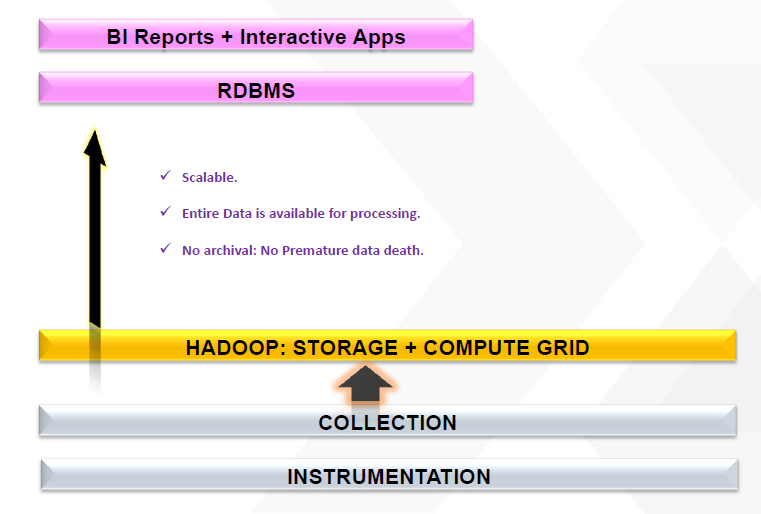
An Emerging Data Architecture


Emerging Data Analytics Architecture


DBMS vs. HADOOP


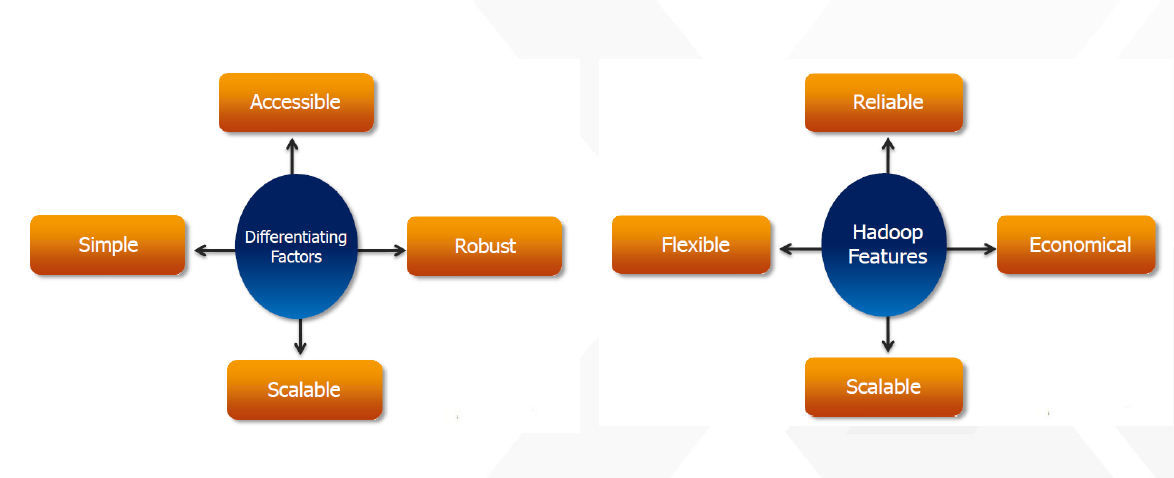
Why Hadoop?


·        Supports use of inexpensive, commodity hardware
                -No RAID needed. Also, the servers need not be the latest                 and greatest hardware.
·        Provides for simple, massive parallelism
·        Provides resilience by replicating data and eliminating tape backups
·        Provides locality of execution, as it knows where the data is
·        Software free
·        High quality support available at modest cost
·        Certification available
·        Easy to support when using GUI such as Cloudera Manager or Ambari
·        Add-on tools available at relatively low cost, or in some cases no cost

·        Evolving technology with a high degree of interest around the world


Hadoop Ecosystem


Analytics mapping – Hadoop 1.x


Analytics mapping – Hadoop 2.x


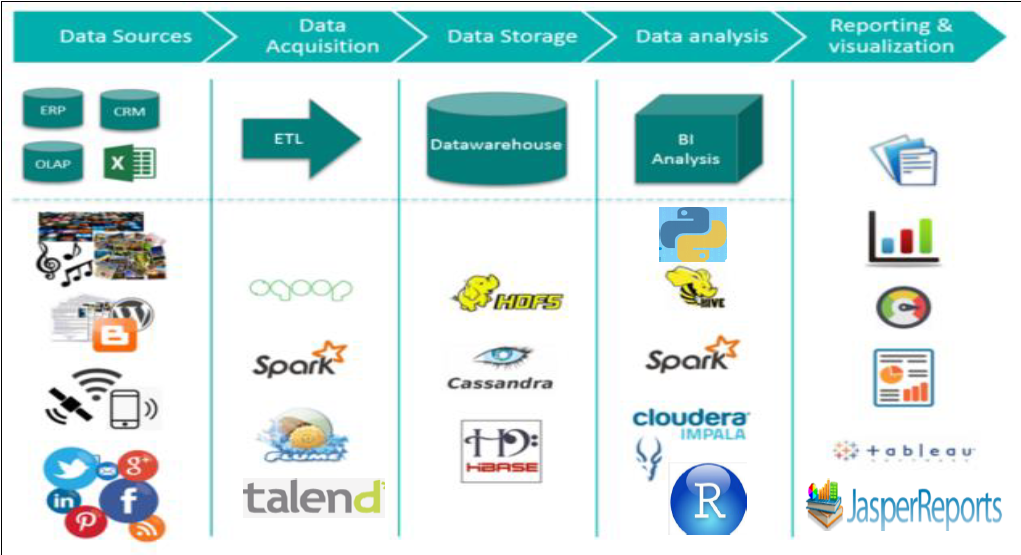
Typical Big Data Project – Role of Hadoop Ecosystem


Opportunity and Market Outlook


Who is using Hadoop?


Which companies Implemented Hadoop?

http://wiki.apache.org/hadoop/poweredBy


Next post would be on Hadoop 2X.......

Used information from Analytic lab